Table of Contents
Let’s start with a moment that everyone is familiar with
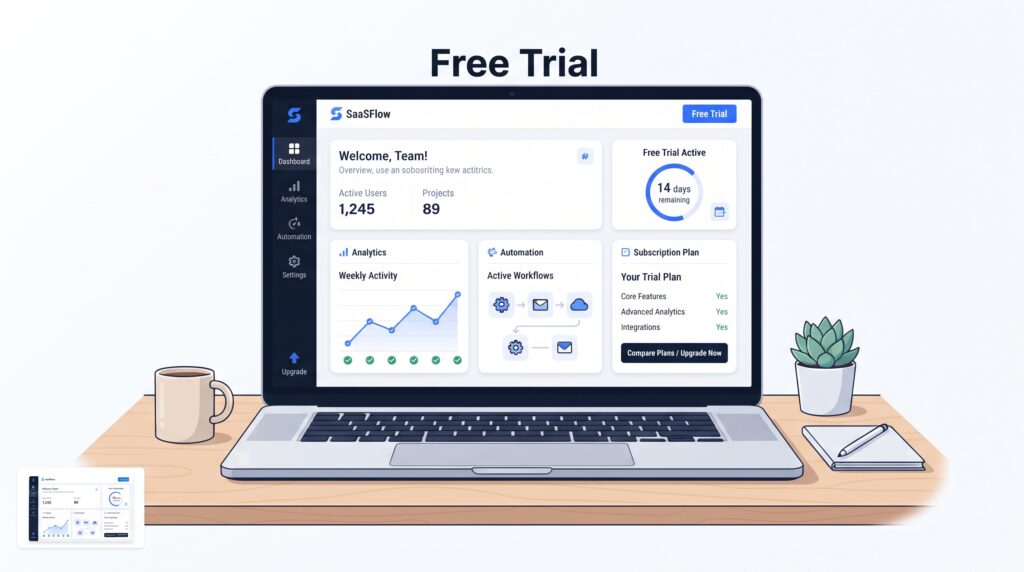
Let’s imagine this scenario together: I signed up for a trial period of a tool that seemed very promising. I spent the first day signing up and setting up my account, so the first day of the trial period was wasted. On the second and third days, I was exploring the main interface and finally starting to understand the tool, when suddenly I received an email saying that the trial period would end tomorrow.
Your feeling at that moment is, “This isn’t fair—I’ve only just started to understand the tool,” But the surprise is that the company knows this feeling and isn’t oblivious to it—it actually plans for it. The question we should ask isn’t “Why isn’t there enough time?” but rather, “Why does the company choose to make the trial period so short, given that it has all this data?”
The Surprise: Short Is the Strategy, Not the Flaw
Here’s what no one tells you: Short trial periods (7–14 days) — and sometimes 30 days — aren’t a shortcoming on the company’s part, but rather the most profitable option for it, based on its own data, Short trial periods accompanied by clear calls to action outperform longer periods (30 days) by as much as 71% in terms of actual conversion rates—but with one crucial condition: the user must reach the true “moment of conviction” before time runs out.
In other words—to put it simply—you aren’t given enough time because the company is stingy; you’re given less time because the company’s internal data has shown, through thousands of users before you, that extra time does not lead to better decisions, but rather to procrastination. Conversion rates in shorter periods—7 to 14 days—outperform those in longer periods—30 days—by 20%, according to Gartner research.
The number that seems to be working against you is actually the result of extensive research that has shown that a long time frame benefits your sense of comfort, not your actual decision.
But Why Does It Feel Like It’s Against You Specifically?
Here lies the detail that will make the idea a little more logical—not just a feeling. Not all tools are equally complex; For example, a simple tool like an appointment scheduling program shows its value within a few minutes, but a complex tool like a CRM system or an analytics platform actually requires a much longer period to convince you—sometimes between 14 and 21 days of actual use, not just browsing.
The real problem, then, isn’t that the trial period is short in absolute terms, but rather that most companies use the same one-size-fits-all approach for all their users, regardless of how complex what they’re actually trying to evaluate is. You’re not slow at making decisions; you’re simply using a tool designed for a timeline that doesn’t match its actual complexity.
| Trial Type | Typical Length | Why |
|---|---|---|
| Simple consumer tools (design, scheduling) | 7-14 days | Fast time-to-value, low price point |
| Complex B2B tools (CRM, analytics) | 14-30 days | More setup, higher price, team buy-in needed |
| No-credit-card trials (e.g. Basecamp) | Up to 30 days | Lower urgency pressure, builds trust first |
| Freemium with usage caps | Unlimited (capped by usage, not time) | Converts based on hitting a feature/usage limit instead of a clock |
It’s worth noting that 41% of the SaaS companies included in the Totango study offer a 30-day trial period, while only 18% offer a trial period of just two weeks—which means that what you consider “insufficient” is actually a common and growing trend, not an exception aimed specifically at you.
The Voice Worth Listening to Next Time
And if you still don’t have enough time, remember this simple fact: the company would rather give you extra time than lose you entirely—because the cost of acquiring you as a potential customer is much higher than the cost of a few extra days. Don’t hesitate to:
And if you still don’t have enough time, remember this simple fact: the company would rather give you extra time than lose you entirely—because the cost of acquiring you as a potential customer is much higher than the cost of a few extra days. Don’t hesitate to:
- Ask support or sales for an explicit extension, especially if you’re an active user who hasn’t made a decision yet
- Looking for a credit-card-free version first (like Basecamp) before committing to a period that ends with an automatic charge to your account
- Identifying your “moment of conviction” in advance instead of aimlessly exploring every feature
The Actual Verdict
The next time you feel like your trial period ended unfairly, remember that this isn’t a technical glitch, but a direct result of the company’s onboarding data—which prioritizes urgency over ease. Truly understanding this mechanism gives you something more important than just self-pity—it gives you a real negotiating tool: Instead of getting frustrated, ask for an explicit extension, or start next time knowing exactly what you’ll base your decision on—from the very first minute, not the fifth day.
Sources
Userpilot, “Free Trial Length in SaaS Doesn’t Matter As Much as You Think in 2026”: https://userpilot.com/blog/free-trial-length-saas/
Ordway Labs, “14 Days vs. 30 Days: Which SaaS Free Trial Length Drives More Conversions?”: https://ordwaylabs.com/blog/saas-free-trial-length-conversion/
Customer.io, “How to choose the right free trial length for a SaaS product”: https://customer.io/learn/product-led-growth/free-trial-length
Maxio, “How Long Should Your SaaS Free Trial Be? It Depends…”: https://www.maxio.com/blog/how-long-should-your-saas-free-trial-be
also read: https://bestimoz.com/what-is-saas-software-as-a-service-explained/